Archive for the ‘culture’ Category

Articles

Poetry instead of PowerPoint in the boardroom

In art,business,China,culture,faith,familiy,Friends,leadership,poetry,Proverbs,quote,Spiritual,Technology,Theology on December 22, 2011 by mstevensrev

A friend and inspiration of mine and many other Nigel Goodwin has an encouraging idea he shares with those creatives in the boardroom.  While spending a few days with Nigel and a group of others at a Kindlings Hearth Event, we had been discussing slippers and lingerie…which is probably an entirely different blog post unless you know Nigel because I’m certain you have discussed similarly unique things with him.  At some point he stops and says, Michael when I do consulting with companies I want to see the humanity brought back into their existence so “When I go into the boardroom I start with poetry rather than PowerPoint.”

While Nigel’s words were inspirational, there was a good part of my heart that sank.  Of course Nigel with his experience and maturity is able to bring those worlds together, he is a uniquely gifted GIFT from God to the rest of us.  As a young, inexperienced, highly ambitious and motivated sales monkey I could not picture that reality, but in that there was hope.  In the short term I embraced bringing the humanity back into those rooms, and noticed results.  With clients such as Google who treat vendors as nameless faceless units and make rational decisions upon the data that has been thoroughly scrubbed for accuracy, it is not easy unless you are intentional.  Though I noticed the more human meetings became, the more laughter there was, the more people longed to have lunch together afterward and there was a small patch of green growing in this area.

That would have been a miracle in mind and the truth be told only God could be responsible for bringing life and humanity to a Google boardroom:)  And yet I had an even bigger surprise yesterday and am grateful that I had the eyes to see what I had stumbled into.  This year has been filled with job transition and the turmoil related to that change.  Thankfully I am celebrating two months with a new company that I am really enjoying and excited about.  Yesterday I found myself in Cupertino at our office with the head of a Business Unit discussing recent shifts within the company and how we are to move forward.  We were setting out a goal for the next three months and clearly came up with the foci and metrics to measure success, yet we had not named our goal.  So I ask the Business Unit head what is mantra for the group.

A grin came across his face and he said that he has a slide on that which he presented.  While finding it on his computer his demeanor shifted from the confident young leader to shy.  He said that often these are the hardest ideas and seem really good in private but are silly in public.  I felt like I was on holy ground.  Then he presented this image to us. Thankfully he did not have the English translation because he was able to share with us more context which made the word so much more than the translation expresses!  It is a quote from Confucius which most people from China know very well, roughly translated it means, “To put the world in order we must first set our hearts to right thing, to then focus on craftsmanship, to then care for family and team, and then the world.”  I have begin to read commentaries and other translations of this proverb and needless to say it is very profound.
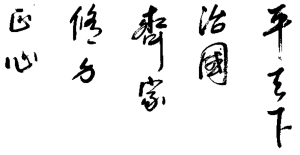
After listening to the explanation I was asked what I thought.  I said it was amazing, the full extent of why I think it speaks to me will take an evening and a meal together but in short is universal and human, capturing and relating what it means for us to be ourselves.  How beautiful to have the opportunity to start with ‘getting our hearts right’ with my co-workers, I desperately need people around me who are concerned with that because it has a direct effect on everything in my life, including my ‘numbers’.  I said, “It is deeply human.”  Then on a level even more deep my coworker asked me with an amazing amount of vulnerability in his eyes and voice, “Is it too Chinese?”  The weight of that question would be hard for me to describe in this blog post, but in short it felt like through this poem/proverb I was being asked if we were all people in a shared struggle with what it means to live in this world.  Again I said it, “It is human, and with roots from China it is perfect for our company.”  There was some more discussion but one of the action items we took away was to send out an audio file of the poem so that the American’s on the team can learn how to say it…as it is mean to be said.

We took a break and before we started again, I told the team about Nigel.  This wonderful friend who brings poetry into boardrooms instead of PowerPoint, and I said he would be very proud of the discussion we had around a poem.  In this I cannot express my gratitude….

P.S. For those of you who haven’t seen the TED Talk related to dance and powerpoint please check it out, this is very dear to my heart.

Dance vs. powerpoint, a modest proposal: John Bohannon on TED.com


Articles

White guilt and african american culture defining America

In art,business,church,culture,design,faith,Theology,work on November 10, 2011 by mstevensrev

It seemed unusual but I gave a presentation in Orlando, FL in 2003 to a classroom of pastors in training titled, “Why you should care about Eminem.”  In it my partner and I traced the thread of influence from the Negro Spiritual to Jazz to Blues to R&B and to Hip Hop as significant influencers of spiritual music, or as Jon Michael Spencer formerly Duke University refers to it Black Sacred Music.  While appropriate for that audience the scope was far too limited, since the practice of American slavery as a oppressed people group African Americans have had greater influence then most realize, the clearest moment I point to is what is known as the Harlem Renaissance .

So this week I watched two interviews that sparked my passions on this topic one again first from the Harvard Business Review titled, The Tanning of America, interview with Steve Stoute.  Perhaps it is my sensitivity but throughout the interview I feel the weight and appreciate Senior Editor Scott Berinato interviewing and awkwardness in using the term Tanning, it both highlights but also takes some of the power out of the white guilt associated with many similar conversations.  That is an aside to the meat of the interview is when Steve Stoute discusses the Madison Square Garden performance of RunDMC.  How they were not only changing music, fashion, but global culture.  The significance that an executive from Adidas had vision in that moment is beautifully redeeming.

For those who have not heard the story, one of our cultures most successful and popular actors Will Smith was deeply influencing by RunDMC. When asked why he got into rap as The Fresh Prince, Smith answered that he saw the video of Run DMC doing a stadium concert in Japan when during the concert they told everyone to hold up their Adidas.  Smith said seeing the influence these guys had over 20,000+ Japanese fans in that moment made him want to get into it.  For those who don’t know the picture in this post is of my current version of the shoes which I grew up with in Baltimore and there is a collectors addition commemorating  the 25th  anniversary of the song My Adidas, available.

The other interview that got me thinking this week was from Inc. with Russell Simmons.  Russell is one of the great culture leaders in our country and the world, this interview also gives him the opportunity to talk about his deep spiritual side to his life and ventures.  He does have one great story he tells about LL Cool J and a commercial for The Gap. Sometimes the most powerful culture changers are clearly in your face but so transcendent that you cannot even see them, and for America there is a great responsibility for it’s citizens to respond to such a beautiful and tragic influence that has so deeply shaped us.

Articles

Getting my kids into the tangable

In art,Books,business,computers,culture,family,k ids on August 11, 2011 by mstevensrev

My work allows me to be around amazing technology and the people who make it.  I have worked intimately with leading companies and gotten to see first hand the artistic nature of writing code and then it coming to life.  For most consumers though this elaborate process simple becomes a means of consuming content, the creative is behind the curtain and often ignored.

I started thinking about this because of a conversation with a new friend where in talking about raising children she mentioned the importance of having books around in addition to the ‘screens’ that are apart of our daily existence.  She said, “I want my kids to have something tangible.”  Which stuck with me.

Tangible things create limits very quickly for us.  That is the magic of technology, Ray Ozzie said that the entire reason he started programming is because he knew if he could imagine it, he could create it.  There is a huge difference though in my mind between creating and consuming.  When I pick up a trumpet I immediately run into the limitations of my lips, training, lungs, and everything else.  When I play a trumpet on Garageband I am free of many limitations.

As a parent of three kids I am often looking for the easy way to get through situations, and I am keenly aware that is not the best.  Hand a kid a screen, and they will be entertained for an hour, teach the kid what about life the screen makes magical and they will be caught up in the wonder of life.


Articles

>Becoming a masterpiece

In Books,culture on October 30, 2010 by mstevensrev

>Did you know that Michaelangelo’s David was made from a piece of marble so ruined it was deemed of no value by other artists? This is what I just read in Dick Staub’s book, About You. There are two parts of this that blow me away. First that artist have to, usually because of cost, work with rubbish to make their art. These are the prophet’s of our age and they are left with ordinary means, often less then ordinary.

Second what a beautiful picture of God’s kingdom. Anyone who thinks of themselves as rubbish and unworthy is exactly who God turns into David. In my own life I recognize God is working with a mess, weak and fragile. The place of faith is believing that there is a David under there and to live in that.

Articles

>Middle-brow culture

In Books,culture,Theology on October 27, 2010 by mstevensrev

>Reading About You, by friend Dick Staub, I came across a concept I found fascinating as Dick recounts a conversation he had on a plane where the gentleman referred to “middle-brow culture”.

“Fleshing out the idea of ‘middlebrow,’ he described highbrow culture as elitist and academic and lowbrow culture as diversionary and vacuous, adding, ‘America once had a thriving middle-brow culture.’ In his definition, ‘middle-brow individuals’ are interested in thinking through ideas and issues, but are turned of equally by both highbrow pretensions and lowbrow mindlessness.”

This is the world in which I live, thoughtful but not academic. I have never been in a classroom that didn’t make my skin crawl unless I was the one teaching;) This group to me are the culture drivers in any society. They are the ones who can take what the culturally elite are thinking, synthesize (though I’m not sure that is the correct term), and push the populous to engage and/or blindly adopt. It reminds me of the movie, White Squall, from the ’90s about young men on a sail boat, and at the moment of crisis ‘Chuck’ Gieg has realized he does not know who he is. One of the other young men on the boat says, “You are the glue. Don’t you get it, we wouldn’t be here if it were not for you, you are the glue that holds it together.” This group is the glue.

Many times those of us who fall into this group feel like less than masters and more like generalist. Perhaps we are more of generalists but that does not keep us from mastery. May those with this gift and calling move boldly and intentionally into the cultural fray. In a world where the amount of content doubles every eighteen months, the ability to name what is good and not evil is extremely valuable. ” C. S. Lewis, in The Abolition of Man, maintained that there are certain acts that are universally considered evil, such as rape and murder. On the other hand, many acts now considered evil have been termed as acceptable in some societies at different times.” This value of this work will be recognized monetarily but also by saving people from despair.